Sup The Elysian Spring
In the late ‘60s, a sleepy college town in Western Massachusetts was home to a smalltime jazz quintet. All these years later, they’re connecting with audiences far beyond their once-limited horizons.
These days, everything comes back around. It’s a double-edged sword.
On the one hand, you might dig up some forgotten gem from the online backwaters; on the other, you might find yourself confronting your own embarrassing past. In a world constantly chronicled, nothing stays buried. If you were going to have some distant relic brought to light, you’d prefer it were something beautiful: that’s exactly how it happened for the members of short-lived Massachusetts outfit Elysian Spring. The plucky college band had a fleeting moment some five decades ago, but their star has never shone brighter.
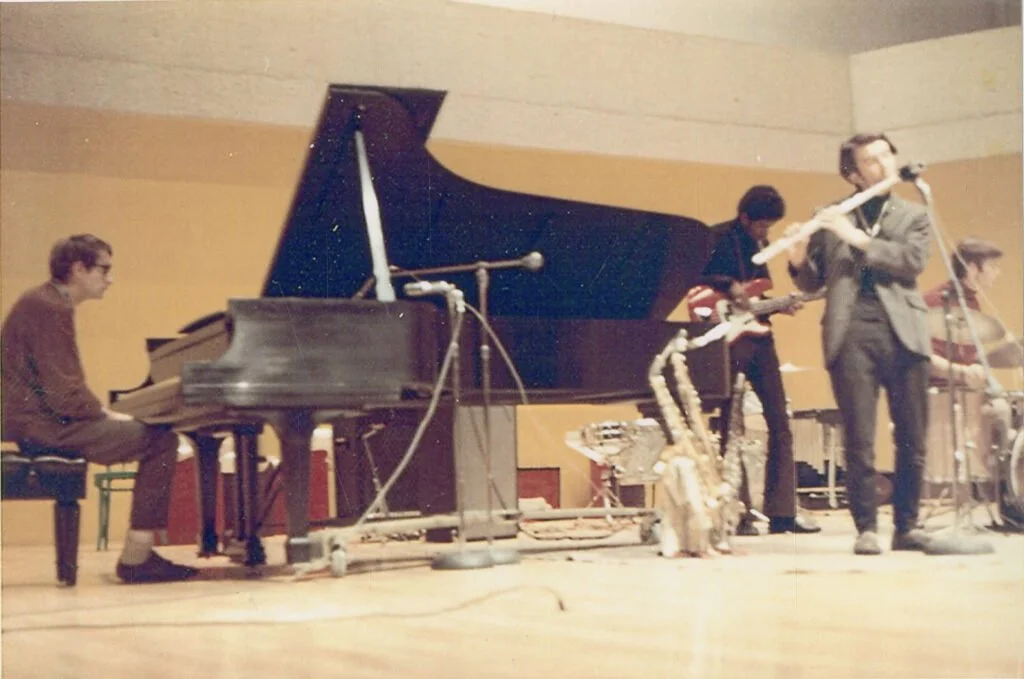
In the late-’60s, in the sleepy town of Amherst, a jazz five-piece was making a minor mark. Elysian Spring played live to keen collegiate crowds, eventually befriending a local radio DJ who invited them to play live in-studio. On stages and in live studios, across semesters and between studies, they pulled together a small collection of recorded music, inadvertently assembling the pieces that would become 1969’s Glass Flowers.
Elysian Spring was pianist Rainer Bertrams, bassist & guitarist Jimmy Bridges, drummer Lenny Ezbicki, saxophonist & flutist Bruce Krasin, and trumpeter Jerry Mirliani. Bertrams and Ezbicki, who shared composition responsibilities, met when Ezbicki jumped in after the mid-show resignation of Elysian Spring’s previous drummer. It was, as Bertrams recalled, an instant connection. “Lenny, who at the time was part of the audience, noticed and approached to help us… after the first few bars leading into our rendition of Dave Brubeck’s ‘Take Five,’ we immediately knew we had our man.” Jerry Mirliani’s father, Frederick ‘Doc’ Mirliani, was a celebrated musician in his own right, working as the band and chorus director at the Amherst Summer Music School throughout the ‘70s.
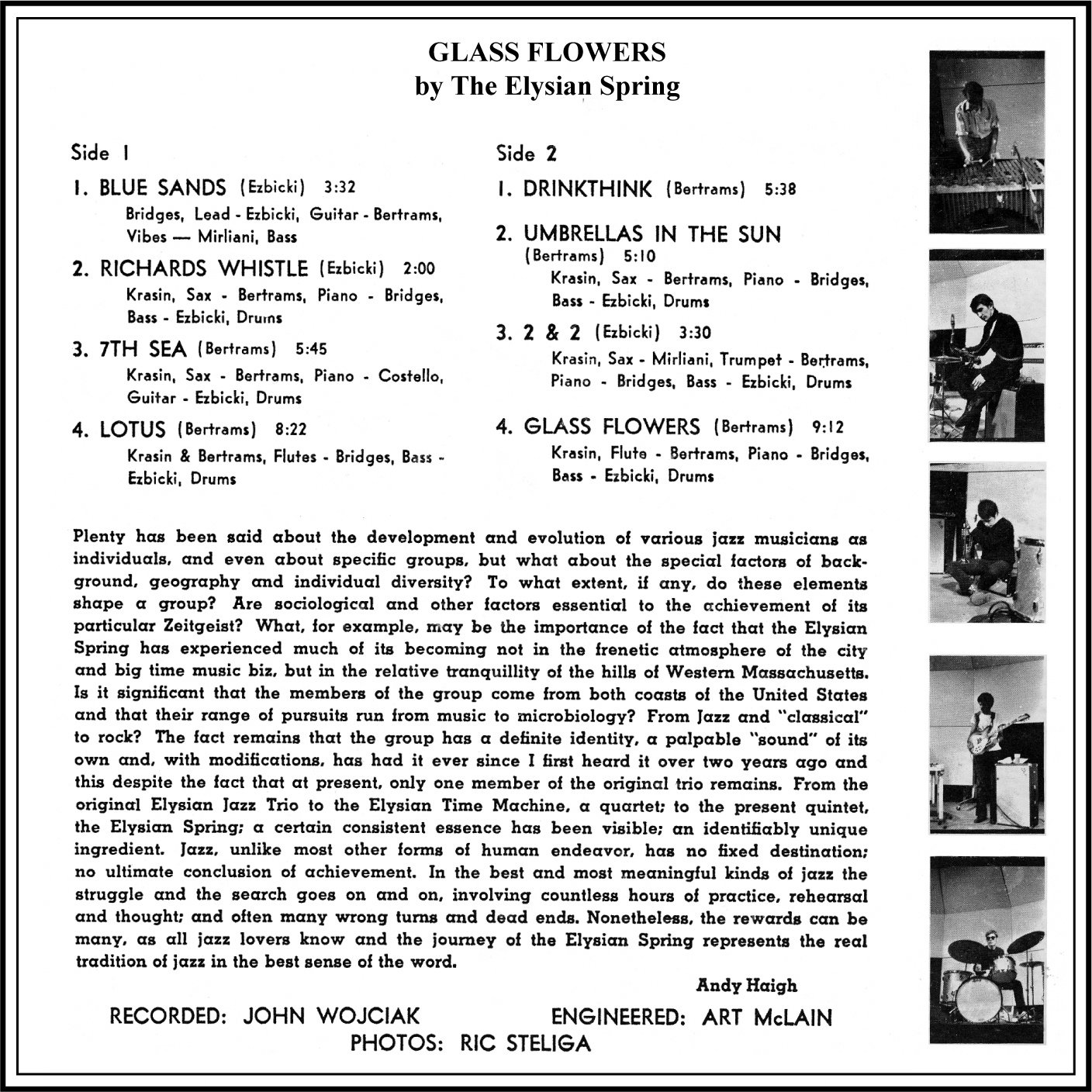
The UMass Amherst Music Department was, by one account, a friendly yet traditionalist outfit. Headed by Dr. Philip Bezanson, a reclusive fellow known for the “somber expression on his face,” the department focused primarily on European classical modes through the late-’60s. As one student notes, up until 1972, there “was never any hint of actual movement towards the development of a Jazz or Popular music oriented curriculum.” Nonetheless, as Glass Flowers shows, there was a significant appetite for jazz, not only amongst the Amherst students, but members of the music faculty. The slight album notes were written by Amherst music librarian Andy Haigh, described as “at least 50 years old, medium build with graying hair, and [sporting] a terrific beard and mustache.” A fastidious record keeper prevailing over an underfunded repository, he predicated his notes on a series of questions:
What about the special factors of back-ground, geography and individual diversity? To what extent, if any, do these elements shape a group? Are sociological and other factors essential to the achievement of its particular Zeitgeist? What, for example, may be the importance of the fact that the Elysian Spring has experienced much of its becoming not in the frenetic atmosphere of the city and big time music biz, but in the relative tranquillity of the hills of Western Massachusetts. Is it significant that the members of the group come from both coasts of the United States and that their range of pursuits run from music to microbiology?”
He notes the strange journey of the group, who were initially the Elysian Jazz Trio, then the quartet Elysian Time Machine, before finally becoming the five-piece Elysian Spring. The commitment to their mantle is perhaps the most enduring part of the band, with just one original trio member appearing on Glass Flowers. That member, Rainer Bertrams, explained the origins of the name in his 2018 interview with Le Très Jazz Club, tracing it back to mid-’60s California. “In Berkeley, I had formed a jazz-oriented experimental trio which was more interested in natural sounds rather than adherence to classical musical structure,” he explained. “By natural sounds I mean those sounds heard in nature, the sounds of real beauty, those of forests, meadows, metals, gongs, bells and winds. In an attempt to recreate the feeling of such sounds the musical result was an ethereal panorama reminiscent of the Greek fields of Elysium.”
Elysium, or the Elysian Fields, is a heaven of sorts, populated by the righteous, heroic, and blessed. It might not be the first place that springs to mind, but were you to be so spiritually rewarded, you could do worse than Western Massachusetts. Haigh’s observation about those dells rings true, with “Blue Sands,” the record’s opening track, a saunter, patient and quietly forlorn. It wouldn’t be out of place in a downbeat meditative playlist, sitting somewhere alongside Galt MacDermot and Cortex. It’s chased by “Richards Whistle,” which does away with that carefully cultivated restraint, landing like a left hook of brisk bop energy. It relents again on the suitably titled “7th Sea,” thick with brushed atmospherics and led by Krasin’s almost-mystical saxophone. This meditative mood channels a sort of natural spirituality, one shaped by the rolling hills of Massachusetts.
“The spiritual vibe is best explained by the composition ‘Lotus’,” proffered Bertrams in his interview. “In the late summer of 1965 the sunset over the hills of western Massachusetts unfolded like a divine lotus replacing the evening's glow with a melliferous flow of arpeggios echoing from a lone soprano flute.” The duelling flutes on “Lotus” dart across the lumbering bass and cavernous kit, breaking through like the rays of a sinking sun, fading out as the dusk takes hold. The brisk “Drinkthink,” which opens on the ambiance of a crowd, is similarly flute-first, with the pleasant melodies giving way to an eerie vibraphone and bursts from a cacophonous drumkit.
“Umbrellas in the Sun” is a milder amble, with Krasin’s commanding sax held down by a steady backbeat. You can feel the depth of the classic four-piece, and it’s not hard to picture the room in which they’re playing, with light refreshments ferried and champagne flutes aloft. Even more spacious is “2 & 2,” a similarly punchy Ezbicki composition that adds Mirliani on the trumpet. The record builds towards the spacious title track, a ten-minute live recording held down by Bridges’ sturdy walking bass. Ezbicki’s kit shares the load, and Bertrams’ piano augments throughout, but it’s Krasin’s flute work that takes centre stage. The wind melodies break through the recording, punctuated by audience applause. This is Elysian Spring in their element, the only one they’d ever aspired to – that it endures some 60 years later is testament to just how well they owned it.
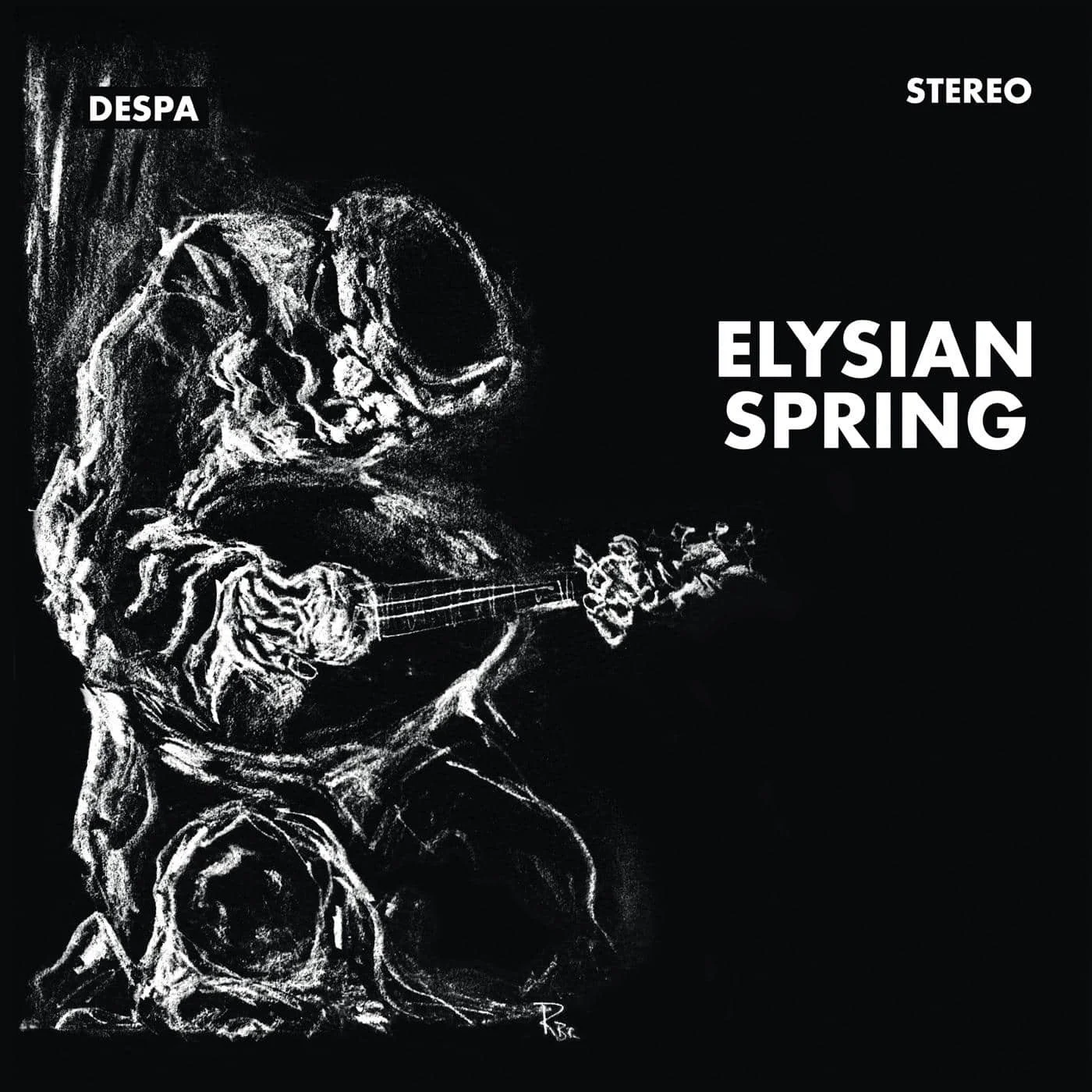
Glass Flowers was originally released by ‘Despa,’ less a true label and more a collection of “desperate students” who put together the money for the 600-copy original press. It was assigned the catalogue number 349, suggesting a trove of yet-undiscovered records sitting somewhere in MA. In 2009, there was a minor CD reissue from the now-defunct Japanese-based label Creole Stream Music, which received some scathing reviews over sound quality. This was righted in 2018, when French label Le Très Jazz Club – a sublabel of Modulor – reissued the record alongside the rare Bertrams interview quoted throughout this piece.
Elysian Spring was never the endgame, and the band went to the wind, leaving Massachusetts behind and splintering into the rest of their lives. Ezbicki and Krasin finished their studies at Berklee School of Music, with Ezbicki becoming a real estate broker and Krasin working as a microbiologist; Bridges went on to play with The John Betsch Society, who released a well-regarded jazz obscurity; Mirliani became a music teacher; and Bertrams is a visual artist in Nevada. Given their inauspicious beginnings, the cult recognition they’ve attained is staggering, but in the grand scheme, it’s little more than a devoted posse.
The group’s graduation came at an important musical juncture for UMass Amherst. In 1971, geologist Randolph Bromley became one of the first African-Americans to serve as Chancellor of a majority-white university. He revitalised the music department, quickly hiring jazz legends Archie Shepp and Max Roach, both of whom would go on to teach at Amherst for decades.
These postings notwithstanding, Western Massachusetts isn’t exactly a fount of jazz. Glass Flowers speaks to the interesting experiments existing on the periphery, pursued far from the bustle of the scene, cut for little more than a love of the craft. It’s a great record for a rainy day, or a late-afternoon stroll as the sun starts to sink. There are a few songs here in rotation, and they pair well with an aimless wander through Prospect Park or a long walk home through Bedford-Stuyvesant. Spring is coming, despite signs to the contrary — take these songs with you and apply them appropriately.